
Hidden in Plain Sight - a series of articles by Leighton Buzzard resident Michael Coram

This is the second article in a series based on the idea of 'hiding in plain sight'. There are many glorious and enchanting things to be seen in Leighton and yet some are invisible to us even though we might pass by them every day. There is mystery in the unseen.
The concept of hiding in plain sight relies on the discrepancy between all that we see compared to what we actually notice. Seeing is not a straightforward act but one that involves interpretation shaped by our family, politics and approach to life. We do not see reality but a story created for us by our imagination.
Camouflage is a good starting point as it is designed to fool the eye.You only have to try to identify birds to discover how well disguised they are when the flit about. Camouflage was first used in 1800 by soldiers who wore drab uniforms instead of the traditionally bright ones. In 1915 it was developed by the French to hide huge items like weaponry and whole buildings.
Six months before war was declared Station Q was established at RAF Stanbridge. It had no airfield and was very secret so the whole building was covered by heavy green netting and replicas of lambs and trees were placed on the roof. Enormous amounts of camouflage netting was used in Britain during the Second World War. It was made by cutting up short lengths of green and khaki sacking strips and attaching them to mesh. The netting created patterned shadows, blending into the surrounding environment and made whatever was hidden underneath difficult to spot from the air.
Nearby Bletchley Park was able to hide in plain sight because it looked so ordinary. The codebreakers wore everyday clothes and they worked in ordinary huts. It did not need netting or replicas of lambs because it simply did not stand out as being important.
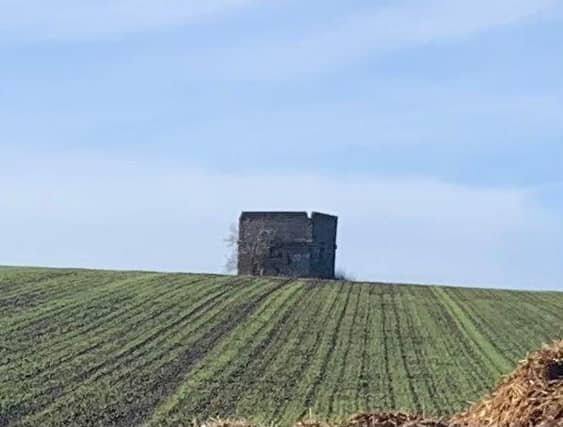
Even though WW2 was 80 years ago there are still some war structures remaining, some may be invisible to us because we perhaps fail to acknowledge them. A prominent example is the pillbox constructed on a hill overlooking RAF Stanbridge. Pill boxes were equipped with anti tank guns.Our one is a type 24 and it is one of only a few left from the many thousands that were built. It is perhaps not well recognised that they formed a continuous stop line across England designed to prevent an enemy advance.
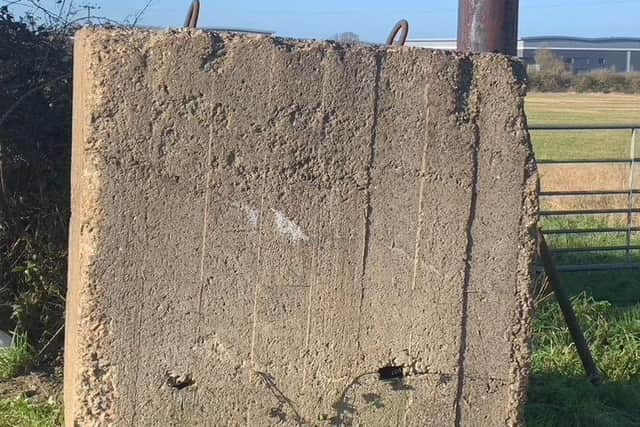
A prime example of hiding in plain sight are the concrete blocks that can be seen scattered around our countryside.They look like ordinary blocks of concrete and yet they have the tell tale eight shutter marks on their sides. They are antitank blocks and might be thought of as a poor legacy of war, they are not as sensational as a pill box. Most were located around our coasts and yet our area was deemed to be so important that they became a fixture.
Most people think of these blocks as simply an inconvenience and yet they were a central feature of our defence as their main purpose was to protect the most important and vulnerable sites. The blocks around Leighton were used to protect the ultra secret RAF base and were placed to work in conjunction with gun cover from the pill box.