
Bedfordshire soldiers laid to rest on the Western Front after more than 100 years
Two soldiers who served with the Bedfordshire Regiment during the First World War have been laid to rest in France, more than a century after they were killed in action.
Private George McIntosh, who died aged 34 in April 1917, was identified through DNA testing after his remains were discovered during construction work on a hospital near Lens.
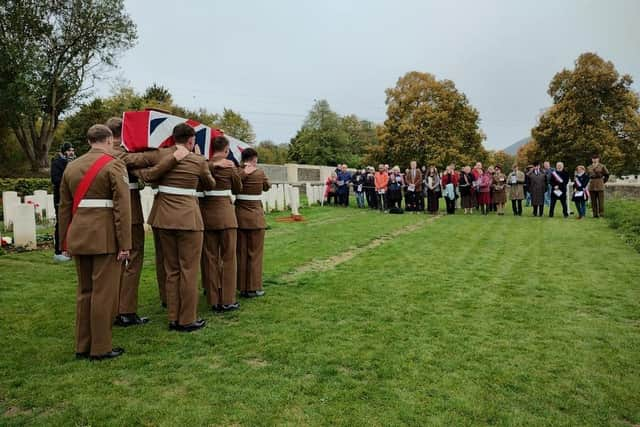

He was buried alongside an unidentified soldier from the same regiment at Loos British Cemetery Extension on October 20.
Ten members of Pte McIntosh's family attended the ceremony, including his great-nephew Jeff MacIntosh, who travelled from North Carolina, USA.
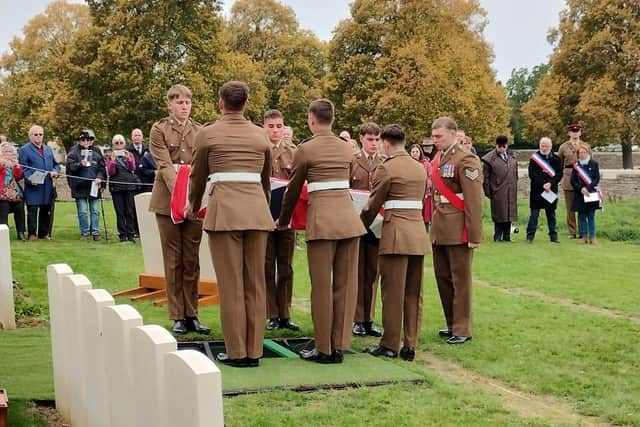
Mr MacIntosh provided the DNA sample that enabled the Ministry of Defence's Joint Casualty and Compassionate Centre (JCCC), known as the “War Detectives”, to confirm his great-uncle's identity.
He said his family had previously known little about his great-uncle's life and death.
"The work of JCCC in connecting George to us via DNA has allowed us to explore his life, what his loss meant to his mother and family, as well as gain a better understanding of the horrors of WW1," he said.
“His story has now been shared with our entire clan, and we are honoured to be in attendance at the ceremony."
Pte McIntosh was born in Ilford, Essex, in 1883 to Scottish parents and grew up in Barnet.
He worked as a gardener and florist before joining the Army and serving with the 8th Battalion, The Bedfordshire Regiment.
He was killed on April 19, 1917, during fighting south of Loos-en-Gohelle, as British forces advanced following the capture of Vimy Ridge by Canadian troops.
His remains were among approximately 100 sets of British and Canadian soldiers' remains recovered during construction of the hospital.
The two Bedfordshire Regiment soldiers were the final British casualties recovered from the site to be laid to rest.
The burial service was organised by the JCCC and conducted by the Reverend Fiona Beale, a chaplain with the Royal Regiment of Fusiliers.
Serving soldiers from several regiments supported the ceremony.
JCCC caseworker Rosie Barron said it had been an honour to meet Pte McIntosh's family and see him laid to rest alongside his comrade.
"His family has travelled a long way to be here, and this shows the depth of what these men still mean to their families even 110 years on," she said.
Efforts to identify the second Bedfordshire Regiment soldier are continuing.
The Battle of Arras started on April 9, 1917. Following the capture of the high ground at Vimy Ridge by Canadian forces, the Douai Plain was open to the Allies.
On the morning of April 18, 1917, 8th Battalion The Bedfordshire Regiment found themselves south of Loos-en-Gohelle. They moved into the frontline and spent the next two days fighting over the location where the new hospital is being built.
The Commonwealth War Graves Commission will care for both graves in perpetuity.