
What do Leighton author Sue Turbett and the World Nomad Games have in common?
Intrepid traveller Sue Turbett has written a novel based on her experiences in Central Asia and she’s desperately disappointed she can’t attend the World Nomad Games in Kazakhstan because of work commitments.
Her book Eagle Sister was inspired by a trip on horseback through the Tien Shan mountains, living with the nomads, meeting the Eagle Hunters and watching the sports featured in the Games.

The former BBC news director, who now runs her own video production business, witnessed these incredible traditional activities, which are included in the UNESCO Intangible Cultural Heritage List, at the Bokonbaevo Nomad Games.
The mother-of-two explains: “They include Kok Boru – where two teams on horseback play a kind of rugby with a headless goat – and horseback archery which entails galloping at full speed while firing a series of arrows into targets.

"There’s also horseback wrestling – dismounting your opponent by whatever means – and yurt building. The fastest team took 17 minutes.”
All a far cry from Sue’s part-time job as a volunteer adviser for Leighton-Linslade Citizens Advice.
She says: “I absolutely love the work – it’s so varied. You never know from shift to shift what issues you will be dealing with to help people resolve their problems.
"It could be a complex debt case, or someone needing to get a birth certificate.”
And she pays tribute to her fellow colleagues: “We’re so lucky to have a fantastic team in the office, all of whom care passionately about what they’re doing.”
And all this a far cry again from her upbringing in West Sussex where she left school at 16 to study classical music in Chichester.
Sue recalls, smiling: “Unfortunately I enjoyed the freedom of living away from home so much I managed to fail the two A-levels I took.”
Next came a secretarial course and she readily admits: “Shorthand and typing are two of the most useful skills I have ever acquired.”
They gave her entry to the BBC, initially as a secretary and then to a long career through radio (on the Today programme) and into television where she ended up directing not only live news and current affairs programmes but also major multi-camera outside broadcasts, such as Princess Diana’s funeral and the aftermath of the 9/11 terrorist attacks in America.
She now has her own company helping large corporates with internal communications, as well as producing pro bono films for international charities.
Her Central Asian adventures were inspired by Peter Frankopan’s book Silk Roads.
Sue says: “I became particularly fascinated by their history and travelled to China, Armenia, Georgia and Azerbaijan – all countries on this route.
"This left a big gap – Central Asia – so in 2018 I joined a small organised group and we travelled overland for four weeks through Turkmenistan, Tajikistan, Uzbekistan, Krygyzstan and Kazakhstan.”
And it was during this trip that the plot for a novel began to emerge: “I could see a girl on a horse, galloping across the steppe, with an eagle flying overhead . . . ‘In the unforgiving landscape of 13th Century central Asia, a mute shepherdess finds a baby golden eagle, unleashing a powerful alliance. But can she survive betrayal, revenge, love and war to save her clan?’"
Sue wrote on the bus for three hours solid and, a year later, returned to Kyrgyzstan for more research.
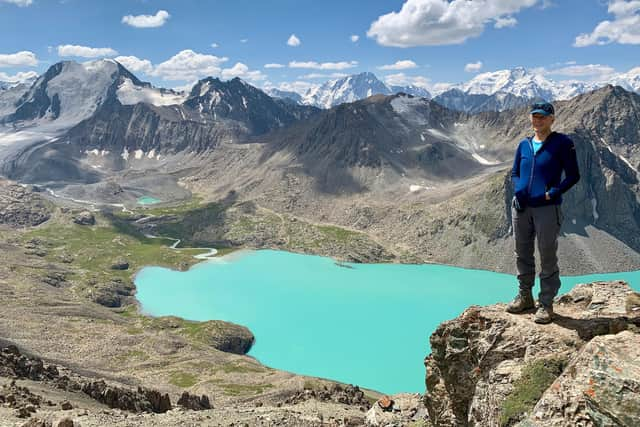
She and a friend travelled on horseback to the Tien Shan mountains to meet the nomad people and, in particular, the men who trained golden eagles to hunt.
She’s ridden all her life and loved the small, fast and responsive steppe horses. But she’d never encountered a wooden saddle before: “No matter how many blankets I added, the journey left its mark. I will say no more . . .”
Sue lived in yurts, ate beshbarmak (basically meat in water, with a carrot if you’re lucky) and drank fermented mare’s milk in order to bring an authentic, first-hand experience to her writing.
She recalls: “The nomads were very welcoming. Sharing food and hospitality is central to their culture. However language was a barrier – but Google translate is a wonderful thing.
"Keeping clean was not an issue. When they set up camp at their summer pastures, they erect a special tent that acts as a sauna, fuelled by horse dung.
"Half an hour in there, followed by a bucket of cold water shower, and you feel as good as new.”
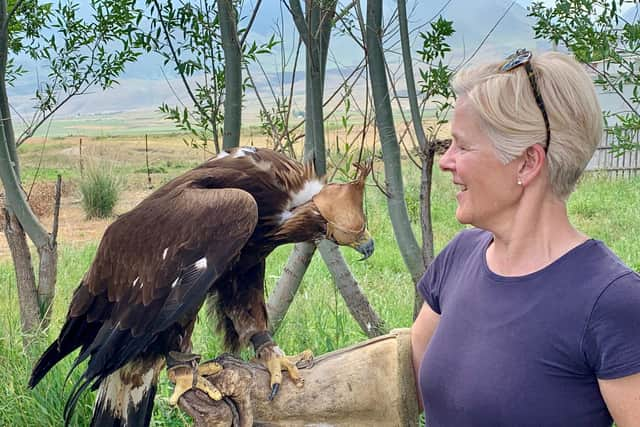
The highlight of her trip was meeting Nurbek Chintemirov and his hunting eagle Karaluk: "He looked at her with such love and affection it wasn’t hard to see they had a strong bond.”
She was nervous, thrilled and honoured to be allowed to hold Karaluk – her arm protected from the eagle’s fearsome 6cm talons by a thick leather glove: “I got a real sense of her astonishing power but couldn’t hold her for long because she was very heavy.”
It took Sue four and a half years and multiple drafts before her debut novel, Eagle Sister, was published by Constellations Press earlier this year.
She admits she found it hard: “I had only written short, factual news pieces before so the whole process was new to me and a steep learning curve.
"But I knew I had a great story on my hands because my main character – a feisty young woman called Gulzura – would not leave me alone. Whenever I had doubts, or writers’ block, she’d pop up in my head and urge me to keep going. She really, really wanted her story to be told.”
Sue now enjoys spending time talking to book groups, schools and literary festivals about her journey to becoming an author and her passion for Kyrgyzstan, its people and culture.
So will there be a sequel? “Never say never,” she smiles.
Eagle Sister is available from constellationspress.co.uk or Amazon. Visit sueturbett.com for more information.